Enterprise & Critical Facilities
A unified infrastructure reality
For enterprise and critical facilities operators, mistakes are expensive, downtime is unacceptable, and infrastructure decisions must rely on trusted data.

Yet most estates combine legacy server rooms, modernized facilities, colocation space, regional edge sites, and disaster recovery environments. These environments evolve continuously as teams add, move, repurpose, and retire hardware.
Managing this diverse estate across teams, systems, and processes is a major challenge. XpedITe addresses it through Universal Intelligent Infrastructure Management (UIIM), unifying facility infrastructure, IT assets, physical connectivity, real-time monitoring, and operational workflows in one view. Teams get a single operational context for planning changes, resolving incidents, and understanding dependencies.
The objective is practical control of the estate—not an idealized, brand-new data center. XpedITe replaces spreadsheets and disconnected tools with a reliable baseline for daily operations, expansion planning, and compliance audits.

The operational reality
The real-world challenges of critical infrastructure
Many of the operational teams we collaborate with are highly skilled and dedicated, yet they are forced to make critical decisions using fragmented, unreliable data. When managing critical facilities, several operational challenges frequently get in the way of efficiency and uptime.
Fragmented databases and the spreadsheet trap
Asset data is often split across IT spreadsheets or CMDBs, facilities files, and network patching schedules. A change recorded in one place leaves the others outdated, creating conflicting versions of the truth, manual verification, and deployment risk. Staff may spend hours reconciling records before work can begin, yet remain unsure which source is current.
The silo between facilities and IT
IT assets depend on power and cooling, but facilities and IT are often managed separately. Without shared physical context, teams cannot readily see how an IT change affects the power chain or which business services will be exposed during cooling maintenance.
Undocumented changes at remote and edge sites
Distributed sites may rely on branch technicians or outsourced smart hands. Without synchronized change control, temporary patches, retired equipment, and cable changes go undocumented. Remote sites become black boxes, and engineers travel simply to confirm rack space or port availability. The resulting uncertainty slows rollouts, increases support costs, and makes emergency work harder to control.
Stranded capacity and unbalanced loads
Apparently full facilities often contain stranded capacity. A cabinet may have free rack units and ports but lack cooling headroom or balanced power. Unless space, weight, power, cooling, and connectivity are assessed together, operators risk localized outages or fund avoidable expansion.
The UIIM approach
Connecting the physical, telemetry, and logical layers
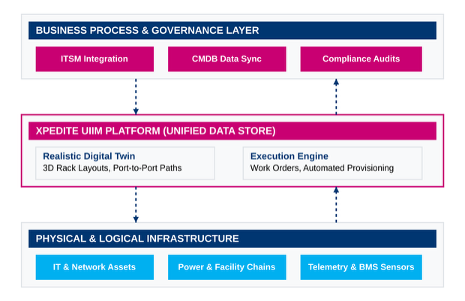
UIIM bridges these gaps by connecting physical infrastructure, live telemetry, logical assets, and business rules in an active operational layer—not merely a monitoring tool or static asset register.
XpedITe integrates rather than replaces systems such as building management (BMS) and IT service management (ITSM). Its federated data store creates an accurate estate-wide digital twin, mapping assets to card, port, and slot level and tracing end-to-end power and data connectivity.
This unified model turns infrastructure data into actionable insight across:
Space and weight
Interactive 2D and 3D room, floor, and rack layouts that accurately show dimensions, slot configurations, and load limits.
Network and power cabling
Port-level status for copper and fiber routes, with complete end-to-end tracing.
Environmental conditions
Live and historical power load, phase balance, breaker status, temperature, and humidity data.
Story-driven scenarios
Scenario A: Safely balancing a power phase and recovering stranded capacity
An operations manager must deploy high-density blade servers. Rack space and total room power appear sufficient, but disconnected records cannot confirm load balance across rack PDUs, busbars, and upstream breakers. The team needs a quick answer, but it must be defensible because a poor placement decision can affect live services.
A manual clamp-meter survey is slow and captures only one moment, missing peak demand. Installing from that snapshot could overload one phase during a workload spike, trip a breaker, and cause an outage. Repeating the survey at several load levels would extend the project and still leave the result vulnerable to later change.
In XpedITe, the engineer opens the 3D digital twin and reviews continuous data from smart rack PDUs and upstream electrical systems. The planning engine checks space, weight, cooling, and phase load together. Historical trends show typical and peak conditions, so the decision is based on operating behavior rather than a single reading.
It flags Phase B in the preferred cabinet near its threshold and recommends an adjacent cabinet with balanced phases and suitable cooling. The servers can be placed safely in minutes, avoiding an outage while recovering capacity that would otherwise remain stranded.
Scenario B: Executing a low-risk data center consolidation
A financial organization must move 80 critical server cabinets from a legacy room to a colocation facility. The window is tight, and interdependent applications must move in controlled groups. Each wave must preserve service dependencies while coordinating equipment, cabling, power, access, and field resources.
Traditional preparation requires technicians to inventory hardware and trace cabling manually, yet dependencies may still be missed. Disconnecting a database before dependent web servers could interrupt service.
XpedITe gives the migration team an interactive map of both environments and documents physical and logical dependencies, including connections to switches, patch panels, and power feeds. This shared model helps application, network, facilities, and migration teams agree on scope and sequence before the outage window.
The future rack state is modelled before equipment moves. XpedITe identifies weight, power, cooling, or connectivity conflicts in the target design before they become physical problems. Planners can compare alternatives, reserve resources, and validate the approved configuration without altering the live record.
After approval, visual work orders specify move sequence, mounting positions, and patch connections. Field teams execute a controlled migration with documented dependencies and no unexpected downtime.
Scenario C: Remotely troubleshooting an overheated cabinet without onsite travel
A switch overheats at one of many remote edge sites without permanent IT staff. The alert arrives late on a Friday, when specialist support and travel options are limited.
Without UIIM, the network team must guide an untrained employee, hire smart hands, or send an engineer on a long trip—delaying resolution and increasing the chance of disconnecting the wrong cable. Meanwhile, the temperature continues to threaten equipment reliability and the services that location supports.
XpedITe shows the device’s exact location, front and rear rack elevations, nearby equipment, and environmental sensors in the remote room’s digital twin. The team can investigate immediately from a browser rather than waiting for someone to describe an unfamiliar cabinet by phone.
The thermal map reveals a localized hotspot caused by a failed fan in an adjacent server directing hot exhaust toward the switch.
The engineer traces connectivity, selects a redundant port on an equivalent switch in a cooler cabinet, and assigns a visual work order showing the exact ports and cable IDs. The instructions limit the local employee’s task to a clearly identified, pre-approved change.
A local employee completes the safe patch change in 15 minutes. The engineer confirms the temperature drop remotely and schedules fan replacement for routine maintenance, avoiding emergency travel while maintaining stability. The incident, action, and final condition remain documented for future maintenance and review.
Capabilities and reference outcomes matrix
Grounded, practical performance improvements
The actual operational improvements depend on the data quality, process discipline, and overall integration depth. However, based on comparable, large-scale enterprise deployments, our clients have documented consistent, tangible operational outcomes.
| Standard operational challenge | XpedITe platform capability | Verified reference outcome |
|---|---|---|
| Inaccurate physical asset records, ghost servers, and duplicate data files | Centralized Unified Data Store with interactive 2D/3D digital twin visualization | Up to 50% reduction in physical data discrepancies across different platforms |
| Unnecessary onsite travel and manual floor inspections to check rack space | Web-based remote management and remote virtual rounds | Up to 80% reduction in routine physical onsite inspections |
| Hours spent manually planning server deployments and checking capacity layers | Automated provisioning algorithms that check space, weight, power, and ports together | Up to 95% reduction in planning time, from hours to minutes |
| Implementation errors, incorrect cabling, and undocumented physical changes | Guided change management workflows, approval steps, and visual work orders | Up to 45% reduction in change-related operational errors |
| Wasted energy, overcooling, and unbalanced thermal distribution | Real-time power and thermal monitoring with detailed historical trend analysis | Up to 20% reduction in infrastructure energy consumption |
| Stranded infrastructure resources and premature facility expansion expenditures | Multi-layer capacity tracking and stranded capacity recovery algorithms | Up to 20% increase in existing infrastructure utilization |
| Weeks spent compiling data spreadsheets for internal and external compliance audits | Automated data collection and customizable regulatory compliance reporting | Up to 80% reduction in audit and compliance reporting efforts |
| Slow troubleshooting when physical connections or ports fail on the floor | Interactive end-to-end network and power connectivity tracing | Up to 30% reduction in mean time to resolution (MTTR) |
| Slow deployment of hardware due to manual inventory coordination and delays | Integrated stock control and automated hardware lifecycle management workflows | Up to 40% reduction in overall time-to-service for new rollouts |
The step-by-step maturity journey
A realistic path to operational excellence
Intelligent operations require a trusted foundation. A phased maturity journey delivers practical value at each step while supporting adoption and data quality.
Phase 1
Establish the truth
Build a reliable infrastructure baseline.
Actions
Import spreadsheets, local databases, and partial records. Automated validation identifies duplicates and conflicts, while teams map sites, rooms, rows, and cabinets into an interactive digital twin. Priority should be given to operationally important data rather than attempting to perfect every field at once.
Outcome
A single source of truth for what assets exist and where they are located.
Phase 2
Control daily operations
Embed XpedITe in daily processes so the digital model stays synchronized with physical reality.
Actions
Manage installations, moves, adds, changes, and decommissioning through routed work orders. Link physical tasks to approved requests through ticketing integrations. Roles, approvals, and completion evidence make responsibility clear and changes auditable.
Outcome
Clear visual instructions replace paper and verbal direction, preventing records from drifting from the floor.
Phase 3
Optimize capacity and risk
Use trusted data and controlled processes to maximize efficiency and reduce risk.
Actions
Activate power-chain mapping, thermal monitoring, connectivity tracing, capacity analysis, and impact simulation to expose unbalanced phases, overcooled rows, and stranded space or ports. Teams can test proposed changes against real constraints before committing labor or equipment.
Outcome
Increase safe rack density, recover hidden capacity, defer capital expansion, and reduce localized risk.
Phase 4
Evolve toward smarter automation
Introduce advanced automation only after data and processes are dependable.
Actions
Enable AI-driven provisioning, prescriptive alerts, and event-based workflows. XpedITe can recommend placements, coordinate cross-team task chains, and synchronize updates with enterprise systems. Automation remains governed by established policies, thresholds, permissions, and approval paths.
Outcome
Reduce operational overhead and complete complex planning more quickly and safely, creating a foundation for increasingly autonomous operations.
Integration and ecosystem alignment
Operating as a connected infrastructure bridge
XpedITe operates as an integration bridge between physical facilities, IT networks, and corporate workflows rather than another isolated system. This approach protects existing investments and lets each system continue performing the function it does best.
Standard protocols and integration models support two-way data exchange with existing tools. Integration scope can expand with operational maturity and business need.
IT Service Management (ITSM)
Integrate with platforms such as ServiceNow and Jira Service Management so tickets trigger visual work orders and receive completion updates.
Configuration Management Databases (CMDB)
Synchronize physical coordinates, hardware details, and connectivity records with the enterprise CMDB.
Building and Power Management (BMS/EPMS)
Collect live electrical and environmental telemetry through SNMP, Modbus, and BACnet from UPS systems, generators, circuit monitors, and smart rack PDUs.
As the shared physical context, XpedITe helps facilities engineers, network administrators, compliance teams, and IT managers coordinate decisions using reliable data. The result is faster coordination, stronger auditability, and safer use of available infrastructure.
Find out more about Enterprise & Critical Facilities
Awards & recognition
As pioneers in the data center industry, we are incredibly proud to be recognized for our technical excellence.